Nanoconda for Prop Trading Firms: One Stack From Research to Live

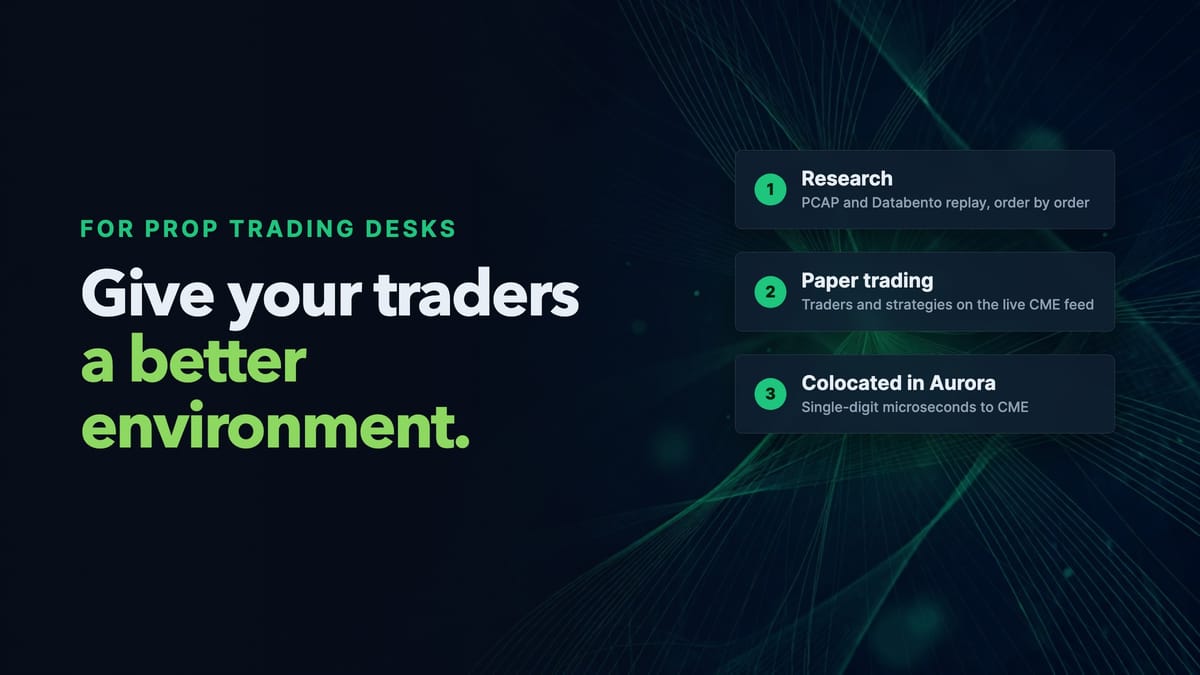
A prop desk moving into CME futures needs two things from its infrastructure. It needs a way to test its execution assumptions and to evaluate traders and strategies before they get capital, and it needs a path to the exchange that is fast enough to matter once they do. Nanoconda connects those stages through one API and one set of trading tools, from replay of recorded data to paper trading on the live feed to colocated execution at about one microsecond order-to-wire.
This post covers what a prop firm gets from putting that stack next to the desk it already runs.
Who this is for
The firms that get the most from it already have the strategy and the traders. What they are missing depends on the desk's stage and its core needs.
- Evaluating traders or porting a strategy. The desk is bringing on new traders, or moving a proven algo from equities or another exchange into CME futures, and needs to see how it behaves on the live book before it gets capital. Paper trading on the live feed, in the same environment as production, is that step.
- Live on a vendor platform and ready for more control. The desk already trades CME through a platform that works for it. Its strategies now depend on things a shared platform isn't built to provide: an order-by-order feed, the exchange's native API, and tighter slippage control. It is weighing a colocated subscription against building its own gateway.
- Live and paying per contract. A semi-manual or intraday desk puts through many trades a day via a GUI like Sierra Chart or a FIX front end, and its routing charges grow with the volume it tries to build. Remote Trading reaches the same gateway in Aurora for a flat subscription with no routing or per-trade fees.
What a prop desk gets
- Independent infrastructure that scales without routing fees. Your own container in Aurora under your control, with no routing charges from us, however much you trade. CME's own exchange and data fees still apply and are billed separately. As many applications and GUI users as the desk needs share the same environment on one subscription, and when a strategy outgrows its cores, you move up a tier rather than buy a server.
- More strategies on one desk. The same environment that runs a discretionary trader from Sierra Chart runs an HFT trader's C++ on the order-by-order feed, and combinations that no retail platform allows: a market maker hedging into a custom spread, a release strategy sharing a session with a queue-position algo, ready-made and custom algos side by side.
- The exchange's own API, one-to-one. No feature reduction and no normalising layer in between: every native CME order type, and the full order-by-order feed with iceberg replenishment under the same order ID.
- Less slippage. A single-digit microsecond path from strategy to matching engine and back means the cancel lands before the stale fill and the order joins the queue where you meant it to.
- One codebase from research to live. Replay, paper trading and production use the same API, so what you tested is what you deploy.
- Oversight built in. Position and loss limits, a kill switch and the full trade log, reachable by the risk manager and by your FCM without access to your code.
Why latency and direct access decide the P&L
Arbitrage opportunities keep getting shorter as systematic strategies become easier to run, and in latency-arbitrage races a few microseconds decide who trades and who cancels in time. Over a slow path, a sound strategy loses money in three ways: the cancel arrives after someone else's aggressive order, passive fills cluster just before the price moves against you, and a late order stands at the back of the queue. A backtest that fills whenever the price touches your level hides the second one entirely.
A path built on a vendor API or a FIX engine adds 10 to 100 microseconds to every order through the kernel's TCP stack and a gateway hop, even next to the exchange. Colocated with Nanoconda, the whole round trip is single-digit microseconds. The colocated tiers also bring the full order-by-order feed that queue and imbalance strategies need, including native iceberg replenishment under the same order ID. Remote Trading carries a ten-level book instead.
Stack that covers three stages a prop desk runs
Research
The Backtesting Simulator replays raw CME PCAP or Databento DBN files order by order through the same API as production, with a Globex-compatible matching model and queue priority. Write in C++, or ship a WebAssembly plugin in C++ or Rust. It also models the matching engine's own latency, which our production measurements put at 50 microseconds to 2 milliseconds depending on conditions and which a backtest with instant or fixed-delay fills leaves out, so a strategy that only works with instant fills shows up before it costs anything. Every run writes a nanosecond trace that can be replayed deterministically. The simulator runs on your own machines with no FCM or exchange account.
Paper trading: qualifying traders and strategies
The simulator's second mode is paper trading on the live CME feed with no code changes, where a trader or a strategy proves itself before it gets capital. The candidate uses the same GUI or API as the live desk, so nothing changes when moving to a live account. Oversight is built into the platform: a pre-trade risk layer with position and loss limits and a kill switch, accessible to the risk manager via the GUI or Remote API, plus a trade log of every order and fill, so the decision to fund rests on the full record.
Production: what prop desks run on it
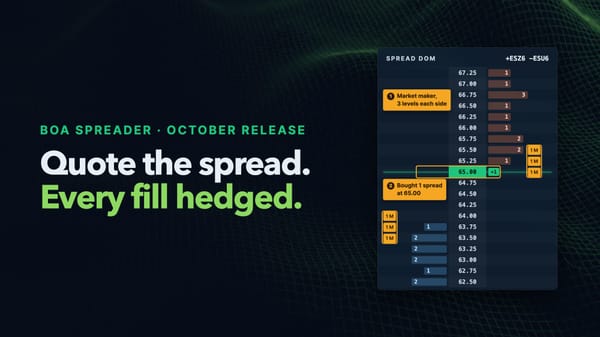
Once cleared for capital, a strategy moves to a colocated tier in Aurora with no code change. The opportunities below are the ones where a fast path and the order-by-order book are the edge, and two of them come as ready-made algos you run from the GUI. Boa Spreader with a single leg makes markets in the front-month ES, quoting both sides inside position and loss limits and pulling its quotes when the book signals a bad fill. With more legs, it defines a spread, such as an ES calendar, ES against NQ, or two points on the curve, rests the quoted legs, and submits the hedge the moment a leg fills, with the source shipping with it. The other two are your own code, in C++ or as a WebAssembly plugin: strategies that react to scheduled releases on a single-digit-microsecond path to the exchange, and strategies built on queue position and book imbalance, which read the order-by-order feed. Server-side smart orders cover the discretionary side of the desk.
What stays yours
Nanoconda is a technology provider, not a broker. Your FCM, accounts and clearing terms stay as they are; the FCM gets the oversight it needs without seeing your code, and your CME data licence remains your own agreement with the exchange. Compile on your own machine and upload only the binary if code privacy matters. We integrate with your FCM during onboarding and keep the certification current through every exchange change, as part of the subscription.
The cheapest way to test any of this is the Backtesting Simulator, on your own data and machine under a three-month licence. Setup and the Remote API are documented at nanoconda.com/docs.