CME Membership Types and Fees: What a Seat Costs and When It Pays Off

CME membership can reduce your exchange fees, but buying or leasing a seat adds costs of its own. Whether it pays off depends on the products you trade, your volume, and the fees you qualify for. We compare trading as a non-member, leasing a seat, and buying one, including the costs that stay the same and the market-data charges that can increase when you become a member.
The short answer (aka tl;dr). Membership is optional. A seat pays off only when the exchange-fee savings on your actual volume exceed everything the seat adds: rent or the cost of the capital, the application fee, and any increase in market-data charges. E.g., for an ES trader leasing an IOM seat, that works out to about 146 round turns a month on rent alone, and 243 a month over the first year once the application fee is included. To run the same math on your own instruments and volume, use our CME Fees & Membership Breakeven Calculator built for selected products.
CME Group offers clearing, corporate and individual memberships. This article covers individual memberships: seats on CME, CBOT, NYMEX or COMEX that approved members buy or lease. Firms can also use these seats through their traders. A clearing firm can register an employee under Rule 106.F, with trades charged at the lessee rate [1, p. 3].
Dates & Sources. Exchange fees in this post come from the CME schedule effective October 19, 2026 [1], the CBOT schedule effective November 1, 2026 [2], and the NYMEX/COMEX schedule effective November 2, 2026 [3]. Where the text compares old and new rates, the older figures come from the superseded schedules in CME archives [4]. Seat prices average the sales CME reported for January – October 2026. Lease prices are CME's own listings as of November 4, 2026. Every dollar figure below is a dated snapshot. It shows where each cost sits and which CME page to check, not a quote: fee schedules change several times a year, and seats trade on a private market, so confirm the live number before you commit.
1. What is a seat, and how do you apply for one?
A seat is the tradeable unit behind Individual Membership: a division-specific interest that entitles its holder to the member exchange-fee rate on whatever products that division covers. This legal structure survives from the exchanges' pre-electronic history, which is why it still trades like an asset with a bid/offer market, rather than working like a simple subscription you buy directly from CME.
Who can apply: any adult with adequate financial resources to take on the responsibilities of membership, and, in CME's own words, "good moral character, a good reputation, and business integrity." [5] Meeting these criteria doesn't guarantee approval; admission is at CME's discretion. Companies use different routes. Individual membership attaches to a person, so a firm uses it through its traders, by leasing seats for them or registering them under Rule 106.F. A firm that wants member rates on its own accounts applies for corporate membership instead, which this guide doesn’t cover [6]. CME's eligibility text doesn't list countries, but that isn't a blanket green light: applicants are subject to U.S. sanctions compliance, and questions about a specific country or entity type should go to the Membership Department.
What you submit, per CME's own application process [5], falls into a few categories: personal and background history (education, employment, residence, and any disciplinary record), financial documentation (a financial statement plus your trading account statement, or a confirming letter if you trade for a firm), identity verification (a passport copy), and the formal paperwork itself (a signed letter of intent and the non-refundable application fee).
Note that CME publishes your name in its Membership Bulletin while your application is pending.
Once approved, you have 30 days to actually acquire a membership, via:
- Purchase — either through CME's seat market, where the membership department posts bids and offers and a trade happens when one is matched or lifted, or through a negotiated sale between two parties at a price between the current bid and offer. In both cases, the buyer has to fund or guarantee the purchase, and a negotiated sale is complete only once CME has both sides' confirmations [7].
- Lease — arranged through your clearing firm, or from the list of lessors that CME publishes on the Membership Pricing page [6].
- Transfer — a firm transfer, gift or family transfer under the membership rules [8].
You can submit a purchase bid at any point: before, during, or after your application is processed, but a lease or transfer can't be finalized until you're approved. If the 30 days pass without an acquisition, the approval is treated as vacated, and CME keeps the application fee. The Membership Department can grant an extension if you ask for one in time [8].
2. The fee stack, top to bottom
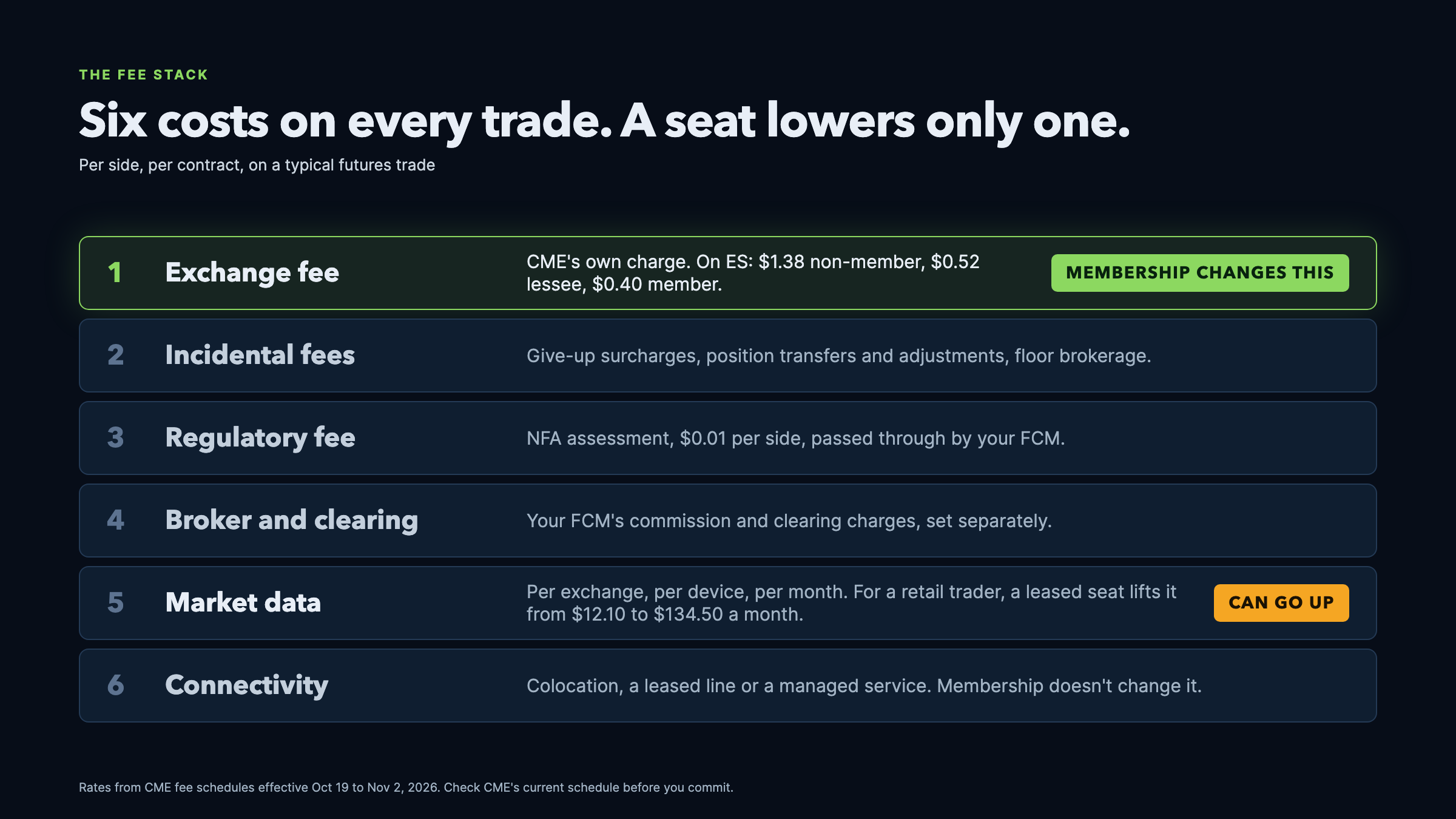
A futures trade carries six kinds of cost. Some brokers roll several of them into one commission line, and others itemize them, but market data and connectivity are almost always billed separately from the per-trade charges.
- Exchange fee. This is CME's own cut, charged per side, per contract. It's the only fee in this list that membership reduces directly. Volume discounts are part of this layer: once your monthly average daily volume crosses a published threshold, the per-side rate steps down, sometimes more than once [1, p. 4]. Section 7.5 below shows where the first step sits for an individual lessee.
- Incidental fees. Smaller charges that apply only in specific situations: give-up surcharges, position transfers and adjustments, and floor brokerage [1, p. 11]. Each has its own conditions and caps, so check the schedule if you use them. None of them enters the breakeven math in section 7.
- Regulatory fee. NFA charges a small per-side assessment, with an increase already scheduled [9]. Your FCM pays it and usually passes it through. NFA's bylaws exempt some proprietary trading by exchange members, with exceptions, so ask your FCM whether that applies to you [10].
- Broker and clearing charges. Your FCM's commission and clearing fees, added on top. Some brokers publish a rate card; others negotiate by volume and relationship.
- Market data licensing. CME bills this per exchange, per device, per month, at different rates for Professional and Non-Professional subscribers [11]. CME has already published a 2027 fee list with increases [12], so check the current list. Membership doesn't discount this layer, and it can raise it: a member, holder or lessee of any exchange membership can't be billed as a Non-Professional [13, §8][14]. For a retail trader, that step-up belongs in the lease breakeven. Automated strategies are a separate case: they usually need non-display licensing, which is priced differently from display devices [11].
6. Connectivity. The network path from your servers to CME's Globex system: colocation, a leased line, a VPN, or a provider's managed service. CME charges for its own connectivity products, such as GLink and colocation [15][16], and third-party providers build those charges into their own fees. Membership doesn't change this layer.
For example, a non-member ES trade at a hypothetical broker commission of $0.85 costs $0.85 + $1.38 exchange fee [1, p. 3] + $0.01 NFA fee (rising to $0.02 from July 1, 2027) [9] = $2.24 per side in transaction charges, before data and connectivity. Membership changes the $1.38 directly. It can also raise your data bill and, in some cases, remove the NFA fee. It doesn't touch the broker commission or connectivity.
Market data works differently. A Non-Professional subscriber pays $12.10 a month for depth-of-market data on one exchange, or $36.50 for all four bundled, while a Professional real-time display device costs $134.50 [11]. A retail trader who leases a seat can no longer bill as Non-Professional, so $12.10 becomes $134.50 on that exchange, an extra $122.40 a month.
3. What membership costs, as of this writing, and where to check
CME Group includes four exchanges, and each exchange has its own separate membership: a CME seat doesn't extend to CBOT, NYMEX, or COMEX products, and vice versa. Trading across exchanges at member rates generally means holding a membership on each. Published exceptions exist, such as CME's Expanded Access Program [1, p. 11].
Each row below is one division, a membership class within an exchange that determines which products you get member rates on and what the seat or lease costs. The B-number after each division is CME’s share-class label for it. Most equity-index and options traders will focus on CME's four divisions.
| Division | Member rates on | Seat, mean (sales) | New lease / mo |
|---|---|---|---|
| CME (B-1) | All CME products | $673,500 (17) | $1,800–$2,600 |
| IMM (B-2) | FX, interest-rate and equity-index futures, plus IOM and GEM products | $175,100 (23) | $900 |
| IOM (B-3) | Equity-index futures, all CME options, random-length lumber, plus GEM products | $36,500 (31) | $250 |
| GEM (B-4) | Emerging-market and restricted financial products | $7,900 (12) | $25 (2026 renewals) |
The other exchanges, for reference:
| Division | Member rates on | Seat, mean (sales) | Lease / mo |
|---|---|---|---|
| CBOT Full (B-1) | All financial and agricultural futures and options | $263,400 (26) | $1,759 |
| CBOT AM (B-2) | All financial futures and options, agricultural options only | $49,300 (20) | $268 |
| CBOT GIM (B-3) | Financial instrument futures | $22,000 (1) | $200 |
| CBOT IDEM (B-4) | Fed Funds and index futures | $3,100 (12) | $33 |
| CBOT COM (B-5) | Options | $6,700 (19) | $49 |
| NYMEX | All NYMEX products (energy, platinum, palladium) | $202,000 (19) | $500 new, $511 renewal |
| COMEX Full | All COMEX products | $114,700 (25) | $500 new, $367 renewal |
| COMEX Options | COMEX options only | $4,000 (6) | Not reported |
Notes: Seat prices are the arithmetic mean of every sale CME reported for January–October 2026, rounded to the nearest $100. CME-division lease prices are the new leases CME reported between September and November 2026 [5]; CBOT, NYMEX and COMEX leases are the monthly means CME publishes for October 2026 [20][21]. Seats and leases trade on a private secondary market, so the averages here show the order of magnitude, not a price you can deal at. The live bid, offer and last sale for every division sit on one page [6]; on November 4, 2026, the IOM market stood at $38,000 bid, $45,000 offered, last sale $41,500. Check it before acting on any figure here. COMEX also carries a $0.50/side surcharge for a lessee trading a non-owned account, on top of the lease itself.
The application fee is a $2,000 non-refundable wire for your first exchange, regardless of division, and $1,000 for each additional exchange [25].
4. Real per-product rates
The table below breaks this down by product group, since different groups sit on different tables of each exchange's schedule and the discount size isn't uniform across them. All figures are per side, for outright futures on Globex, in USD.
| Product | Non-member | Lessee | Member | IIP | Source |
|---|---|---|---|---|---|
| ES E-mini S&P 500 (CME) | $1.38 | $0.52 | $0.40 | $0.75 | [1, p. 3] |
| NQ E-mini Nasdaq-100 (CME) | $1.38 | $0.52 | $0.40 | $0.75 | [1, p. 3] |
| RTY E-mini Russell 2000 (CME) | $1.38 | $0.52 | $0.40 | $0.75 | [1, p. 3] |
| MES Micro E-mini S&P (CME) | $0.35 | $0.11 | $0.08 | $0.18 | [1, p. 3] |
| MNQ Micro E-mini Nasdaq (CME) | $0.35 | $0.11 | $0.08 | $0.18 | [1, p. 3] |
| M2K Micro E-mini Russell (CME) | $0.35 | $0.11 | $0.08 | $0.18 | [1, p. 3] |
| 6E Euro FX (CME) | $1.60 | $0.52 | $0.34 | $0.54 | [1, p. 7] |
| 6B British Pound (CME) | $1.60 | $0.52 | $0.34 | $0.54 | [1, p. 7] |
| 6J Japanese Yen (CME) | $1.60 | $0.52 | $0.34 | $0.54 | [1, p. 7] |
| SR3 3-Month SOFR (CME) | $1.25 | $0.37 | $0.19 | $0.50 | [1, p. 9] |
| ZN 10-Year T-Note (CBOT) | $0.80 | $0.27 | $0.14 | $0.54 | [2, p. 5] |
| CL WTI Crude Oil (NYMEX) | $1.50 | $0.75 | $0.75 | $0.90 | [3] |
| MCL Micro WTI Crude Oil (NYMEX) | $0.60 | $0.30 | $0.30 | — | [3] |
| GC Gold (COMEX) | $1.65 | $0.75 | $0.75 | $1.00 | [3] |
Notes: "Lessee" is the Rule 106.D Lessee row on CME schedules and the Individual Delegate row on CBOT's. "Member" is the rate for an approved individual member; owning a seat as an investor doesn't qualify. NYMEX and COMEX publish a single Member column, which a lessee also receives.
Leasing reduces the ES exchange fee by 62% and the 6E fee by 67.5%. The dollar savings are $0.86 per side on ES and $1.08 on 6E, or $1.72 and $2.16 per round turn. Breakeven depends on these dollar savings and the rent for the relevant seat, so calculate it separately for each product.
5. Membership as capital
When you buy a seat, you acquire an asset you can later resell or lease out. If your trading volume drops or you stop trading that division’s products for part of the year, rental income can offset the opportunity cost of holding the seat. While the seat is leased out, your own trades are charged at non-member rates.
Partial-year terms are negotiated: CME-division leases reported between September and November 2026 ran from three to twelve months [5]. A lease doesn't renew automatically; unless the agreement says otherwise, renewal needs notice and a new agreement, and the rule also covers rent owed if a lease ends early [26]. To see what leasing out part of the year does to your own numbers, set the lease-out months and rent in our breakeven calculator.
6. Why registration is the real gate
CME bills each Globex trade according to the combined membership status of the operator and the account owner [1, p. 11]. The operator is identified by the Globex Operator ID carried in FIX tag 50 [27]. For a discount to apply, your FCM must ensure that the ID is registered in CME’s Exchange Fee System (EFS) against your membership, lease or incentive-program status [28]. The account owner must also qualify for the rate.
Practical takeaway: after acquiring any membership or program status, confirm with your FCM that your specific operator IDs and accounts are registered against it.
7. The breakeven math
Savings per round turn is 2× the per-side savings, because fees are charged per side. Every figure in this section uses the rates and the seat and lease prices discussed above, assumes 21 trading days a month, and rounds up to whole round turns.
7.1 Lessee path
ES rates: non-member $1.38/side, lessee $0.52/side [1, p. 3].
Savings per round turn = 2 × ($1.38 − $0.52) = $1.72.
| What the savings have to cover | Calculation | Round turns / month | Per day |
|---|---|---|---|
| Rent only IOM lease | $250 ÷ $1.72 | 146 | ~7.0 |
| Rent, plus the $2,000 application fee spread over year one | ($250 + $166.67) ÷ $1.72 | 243 | ~11.6 |
| Both, plus the Professional data step-up on the CME feed | ($250 + $166.67 + $122.40) ÷ $1.72 | 314 | ~15.0 |
The last row applies only if you're currently billed as a Non-Professional; leasing a seat ends that status [14]. Traders already billed as Professionals can use the first two rows.
For comparison, a full CME division lease at $2,600/month needs 1,512 round turns a month (~72/day) on rent alone. IOM is the natural first seat for an equity-index trader because its rent is small relative to the ES discount.
The application fee is paid upfront. With the first month’s rent, the initial outlay is $2,250, which takes 1,309 ES round turns to cover. At 30 round turns a day (630 a month), exchange-fee savings after rent are $834 a month, so the $2,000 application fee pays back in about 2.4 months.
7.2 Owner path
Every round turn saves the full member discount from the first trade:
Savings per round turn = 2 × ($1.38 − $0.40) = $1.96.
What the owner puts in: the seat price plus the same $2,000 application fee a lessee pays.
| Division | Seat (2026 mean) + application fee | Saved per round turn | Round turns to earn it back | At 30 round turns a day |
|---|---|---|---|---|
| IOM | $38,500 | $1.96 | 19,643 | ~2.6 years |
| CME | $675,500 | $1.96 | 344,643 | ~45.6 years |
This is a conservative view, because the seat is a one-time purchase, not a yearly fee: you keep it, and you can resell it or lease it out. Against that, add the risk of selling below what you paid, transaction costs on the purchase and the sale, and financing if you borrow to buy.
If you also want to price the capital itself, add an opportunity cost on top. E.g., at 8% a year, an IOM seat ties up about $243 a month, which takes 125 round turns a month to cover. Our breakeven calculator works like the table above: it shows the seat price as capital you hold, pays back only the application fee, and adds no opportunity cost.
7.3 IIP path
CME’s International Incentive Program (IIP) offers discounted exchange fees without buying or leasing a seat. Eligible firms must trade only their own capital and be located and incorporated outside North America [29]. Trading arcades, hedge funds and firms managing client money do not qualify. Participation requires CME approval, a one-time application fee and an ongoing minimum trading volume.
Savings per round turn = 2 × ($1.38 − $0.75) = $1.26.
IIP still has a $2,000 one-time program application fee [29, Q20] and an ongoing minimum of 250 average daily contract sides, assessed each calendar quarter [29, Q13]. Micro E-mini equity-index volume doesn't count toward that minimum. The savings cover the fee after 1,588 ES round turns in total. At the 250-sides-a-day minimum, that's about 13 trading days.
7.4 FX example
6E lessee savings per round turn = 2 × ($1.60 − $0.52) = $2.16 [1, p. 7].
At the 2026 IMM new-lease price of $900/month:
$900 ÷ $2.16 = 417 round turns/month, or ~19.9 round turns/day.
The IMM lease costs $900 a month, compared with $250 for IOM. Although each 6E round turn saves more in exchange fees, the higher rent requires 417 round turns a month to break even, compared with 146 for ES on IOM.
7.5 Tier caveat
The breakevens above use base rates. With higher trading volumes, the lessee and member rates on E-mini futures drop further [1, p. 4]:
| Monthly average daily volume (sides) | Discount per side | Lessee ES rate | Member ES rate |
|---|---|---|---|
| 0–250 | none | $0.52 | $0.40 |
| 251–1,750 | $0.16 | $0.36 | $0.24 |
| 1,751–15,000 | $0.22 | $0.30 | $0.18 |
| 15,001–16,000 | $0.23 | $0.29 | $0.17 |
| > 16,000 | $0.25 | $0.27 | $0.15 |
The tiers count average daily sides, per trading account, so the first step needs about 126 round turns every day. FX and interest-rate futures have their own tiers, starting at 7,501 and 40,001 sides a day [1, pp. 8, 10].
8. Quick reference: six things that trip people up
- All exchange fees are charged PER SIDE, per contract. A round turn pays the fee twice. Model breakeven on round turns, not one-way contract counts.
- CME changes fees without notice. This guide reflects the CME schedule effective October 19, 2026, the CBOT schedule effective November 1, 2026 and the NYMEX/COMEX schedule effective November 2, 2026. Each is the third version of its schedule since mid-September: the October 1 CME and CBOT schedules replaced September 14 versions two and a half weeks after they took effect, and were themselves replaced within a month. Most revisions add products or adjust a handful of rows, but you can't tell which from the filename. Check every number against the current schedule [30] or the Non-Member Fee Finder [31] before you commit capital.
- Membership directly reduces only the exchange fee. Broker and clearing charges are set separately, and leasing a seat can raise your market-data bill by ending Non-Professional status.
- Lease pricing is a negotiated secondary market, not a published rate card, and lease terms are fixed and negotiated rather than automatically month-to-month.
- Micro E-mini products don’t count toward the E-mini volume discounts or toward the IIP volume minimum. A micro-heavy trader sees a smaller payoff, regardless of division or program.
- If your operator IDs are not registered in EFS, you are billed at non-member rates by default, regardless of what memberships you or your firm hold.
To check a seat against your own book, put your products, volume and lease or seat price into the CME Fees & Membership Breakeven Calculator [32]. It is built for a selected list of 36 CME Group futures products rather than the full slate, uses the current schedules, and leaves market data and the cost of capital out of its totals, so add the data step-up yourself if you lease, and the cost of capital if you own
References
- CME Group — CME Fee Schedule, effective October 19, 2026. cmegroup.com/company/files/cme-fee-schedule-2026-10-19.pdf
- CME Group — CBOT Fee Schedule, effective November 1, 2026. cmegroup.com/company/files/cbot-fee-schedule-2026-11-01.pdf
- CME Group — NYMEX/COMEX Fee Schedule, effective November 2, 2026. cmegroup.com/company/files/nymex-fee-schedule-2026-11-02.xlsx
- CME Group — Historical Exchange Fees. cmegroup.com/company/clearing-fees/historical-fees.html
- CME Group — CME Individual Membership. cmegroup.com/company/membership/individual/cme.html
- CME Group — Membership & Lease Pricing. cmegroup.com/company/membership/membership-and-lease-pricing.html
- CME Group — Seat Market Procedures and Instructions. cmegroup.com/company/membership/files/seat-market-procedures-instructions.pdf
- CME Group — Individual Membership Application Instructions & Checklist. cmegroup.com/company/membership/files/IndividualChecklist.pdf
- NFA — NFA Assessment Fees FAQ. nfa.futures.org/faqs/members/nfa-assessment-fees.html
- NFA — Bylaw 1301. nfa.futures.org/rulebooksql/rules.aspx
- CME Group — Market Data Fee List, June 2026. cmegroup.com/market-data/files/june-2026-market-data-fee-list.pdf
- CME Group — 2027 Market Data Fee Notice, August 10, 2026. cmegroup.com/market-data/files/2027-market-data-fee-notice-august-10-2026.pdf
- CME Group — Schedule 5 to the Information License Agreement, August 2026. cmegroup.com/market-data/files/schedule-5-to-the-ila-august-2026.pdf
- CME Group — Non-Professional Self-Certification Form. cmegroup.com/market-data/license-data/market-data-policy-education-center.html
- CME Group — CME Globex Connectivity Options. cmegroup.com/solutions/market-access/globex/connectivity-options.html
- CME Group — CME Globex Customer Connection Agreement. cmegroup.com/globex/files/CMEGlobexConnectionAgrmt.pdf
- CME Group — CME Historical Membership Pricing. cmegroup.com/company/membership/historical-pricing/cme-historical-membership-pricing.html
- CME Group — CBOT Historical Membership Pricing. cmegroup.com/company/membership/historical-pricing/cbot-historical-membership-pricing.html
- CME Group — NYMEX & COMEX Historical Membership Pricing. cmegroup.com/company/membership/historical-pricing/nymex-historical-membership-pricing.html
- CME Group — CBOT Historical Lease Pricing. cmegroup.com/company/membership/historical-pricing/cbot-historical-lease-pricing.html
- CME Group — NYMEX & COMEX Historical Lease Pricing. cmegroup.com/company/membership/historical-pricing/nymex-historical-lease-pricing.html
- CME Group — CBOT Individual Membership. cmegroup.com/company/membership/individual/cbot.html
- CME Group — NYMEX Individual Membership. cmegroup.com/company/membership/individual/nymex.html
- CME Group — COMEX Individual Membership. cmegroup.com/company/membership/individual/comex.html
- CME Group — Application and Transfer Fee Schedule, All Exchanges. cmegroup.com/company/membership/files/cme-membership-fee-schedule.pdf
- CME Rulebook — Chapter 1, Membership. cmegroup.com/rulebook/CME/I/1/1.pdf
- CME Group — Globex Operator ID (Tag 50) registration. cmegroup.com/tools-information/webhelp/cme-customer-center/Content/tag50.html
- CME Group — Exchange Fee System (EFS) WebHelp. cmegroup.com/tools-information/webhelp/efs/Default.html
- CME Group — International Incentive Program (IIP): Questions and Answers. cmegroup.com/company/membership/files/InternationalIncentiveProgramQA.pdf
- CME Group — Exchange Fees for Clearing & Trading. cmegroup.com/company/clearing-fees.html
- CME Group — Non-Member Fee Finder. cmegroup.com/company/clearing-fees/fee-finder.html
- Nanoconda — CME Fee Calculator. cmemembership.nanoconda.com