Categories
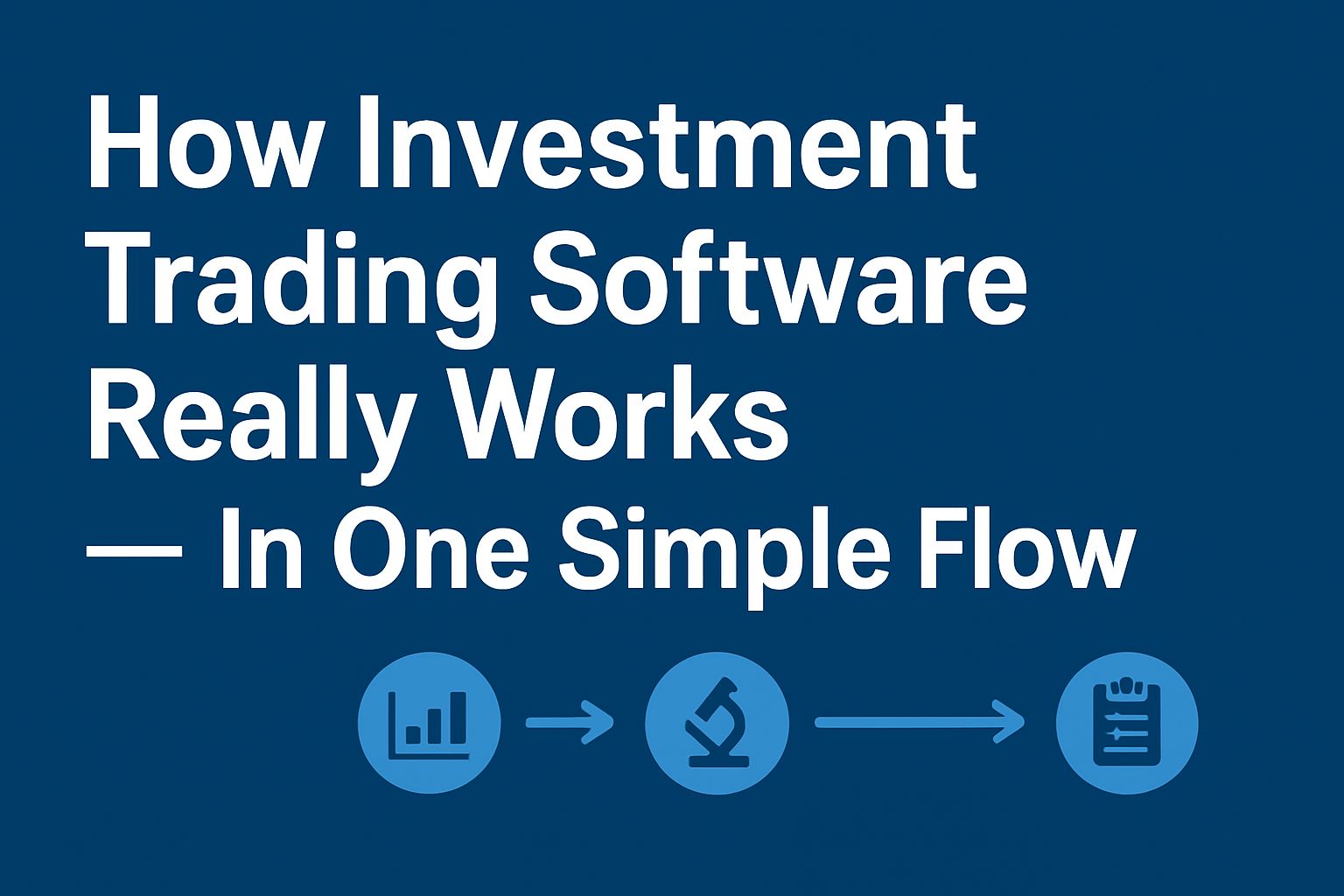
How Investment Trading Software Works — In One Simple Flow
November 12, 2025 - Reading time: 7 minutes
Most traders only see the interface — the glowing charts, blinking P&L, and trade buttons. But underneath, there’s an entire system designed around one goal: giving you faster, fairer, and more direct access to the market.
Investment trading software isn’t just technology — it’s the infrastructure that determines how efficiently your strategy becomes a live order. Whether you’re trading futures or equities, every edge starts with how your order moves from idea → signal → execution.
🧩 The Building Blocks
Every platform runs on a combination of hardware and software, but what really matters is how they connect you to the exchange.
-
Hardware: Servers, low-latency networks, and devices stationed near exchange data centers (like CME Aurora or Eurex Frankfurt).
-
Software: Data feeds, analytics engines, order routers, and risk tools that interpret and act on real-time information.
-
Cloud infrastructure adds scalability and flexibility — helping firms expand without buying racks of machines.
-
Machine learning improves signal quality, helping traders make more adaptive and data-informed decisions.
Together, these layers form the foundation for what we now call Direct Market Access (DMA) — a setup where your trades go straight to the exchange without broker delays or hidden routing.
🔁 The Flow — From Data to Execution
Here’s the full cycle simplified:
-
Data Collection — Streams from exchanges, news, and alternative data sources are cleaned and normalized.
-
Signal Generation — Analytics and AI models identify opportunities using technical and statistical indicators.
-
Decision & Risk Control — Algorithms evaluate those signals within risk parameters before sending orders.
-
Order Execution — Orders route directly to exchanges via DMA — minimizing latency and maximizing control.
-
Monitoring & Adjustment — Systems track open positions and market changes in real time.
-
Reporting & Compliance — Every transaction is logged transparently for post-trade analysis and audit.
Each step supports one idea: speed plus transparency equals better control.
🧠 Integration, Reliability & Security
Trading platforms rely on standardized protocols like FIX and ISO 20022 to ensure all systems — from analytics tools to exchanges — speak the same language.
Reliability is everything. Downtime means lost trades, so modern setups use redundancy, failover systems, and real-time monitoring to stay online even in volatile markets.
Security is the next layer — encryption, multi-factor authentication, and network isolation protect both data and capital.
It’s not just compliance — it’s survival.
💰 Cost, Value & Growth
Performance comes with a price.
Low-latency infrastructure, colocation servers, and data licenses all carry costs, but the real ROI comes from execution quality — fewer delays, tighter spreads, and consistent fills.
For smaller trading firms, cloud-native DMA setups are closing the gap with large institutions.
It’s no longer about who has the biggest hardware budget — it’s about who has smarter access.
🌍 Who Uses It
-
Hedge Funds: Running algorithmic and arbitrage strategies with millisecond precision.
-
Retail Traders: Leveraging user-friendly tools built on the same market plumbing as institutions.
-
Banks & Asset Managers: Managing risk, compliance, and execution across multi-venue strategies.
DMA has become the great equalizer — shrinking the distance between a retail setup and a professional desk.
🔮 Outlook — The Future of Access
The next generation of trading systems will merge AI, automation, and direct access into a unified experience.
Expect smarter routing decisions, predictive analytics, and continuous optimization.
As exchanges open more APIs and data centers expand globally, the barriers between “big player” and “small participant” continue to fade.
Because in the end, trading edge isn’t only about milliseconds — it’s about how much control you actually have over them.