Categories
Algorithmic Trading Certificate (ATC): Practitioner-Focused Foundations for Systematic Execution Teams
November 3, 2025 Reading time: 7 minutes
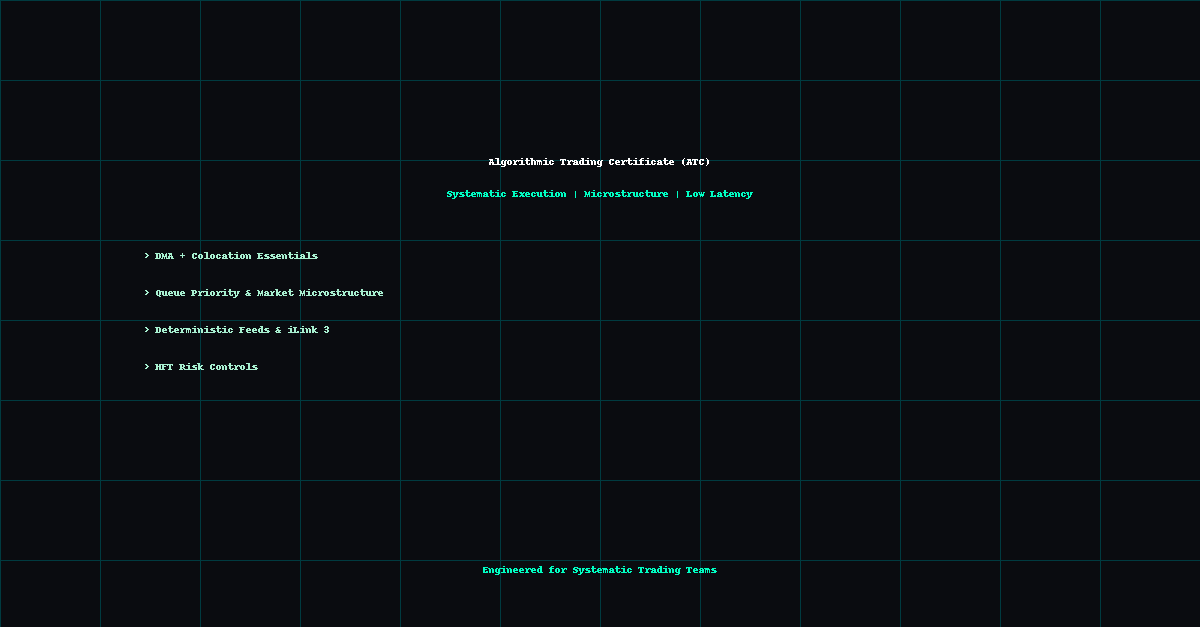
Developing institutional-grade automated trading systems requires a foundation that integrates market microstructure, execution design, measurable latency, and robust model validation. The Algorithmic Trading Certificate (ATC): A Practitioner’s Guide from WBS Training provides that grounding with an emphasis on real-world engineering and trading constraints.
This introductory Primer strengthens the operational understanding required for:
-
Colocated execution environments
-
Direct Market Access workflows
-
Deterministic market data handling
-
Model lifecycle governance in production trading systems
What This Primer Actually Teaches (Through an Engineering Lens)
Microstructure & Matching Engine Interaction
Participants learn how markets behave at the message level: queue priority, auction mechanics, replenishment logic, and why volatility auctions, circuit breakers, and tick size regimes directly shape fill probability. Concepts like MDP 3.0 sequencing, FIX/iLink 3 throttles, and gateway congestion are framed as execution constraints—not abstract theory.
Strategy Design with Deployment in Mind
Data engineering is addressed with a focus on timestamp precision (PTP sync), drop detection, and jitter propagation through forecasting pipelines. Feature engineering and alpha modeling are tied to latency budgets so participants understand where microseconds are gained or lost.
Execution Algorithms & Slippage Control
The program connects prediction output → child order scheduling → venue selection. Practical modeling of slippage, queue position loss, and adverse selection is included alongside risk controls such as:
-
Fat-finger & price collars
-
Max order size and position constraints
-
Kill-switches and cancel-on-disconnect logic (exchange-level CbOE/ICE)
The case study includes an intraday strategy deployed in simulation with measurable per-venue routing impact and market impact attribution.
Why It Matters for Trading Infrastructure Teams
Most training programs focus on signals. This one forces practitioners to consider:
-
FPGA vs software execution: pre-trade risk offload, determinism vs flexibility
-
Kernel bypass networking (e.g., TCP Direct, Onload) and its impact on tail latency
-
Feed arbitration and sequencing gaps in high-rate bursts
-
Backtesting validation that accounts for queue position and microstructure slippage, not midpoint fantasy fills
Real trading requires deployment realism. The Primer emphasizes this.
Audience Fit
Engineers, quants, and execution specialists who:
-
Are building or evaluating production trading infrastructure
-
Need fluency between strategy modeling and microsecond-level execution constraints
-
Want a structured path into systematic trading roles with hands-on, code-first modules
3 Technical Takeaways
-
Latency is part of your alpha decay model — forecasting without execution timing assumptions misstates performance.
-
Market data integrity is risk control — dropped, stale, or reordered packets distort both forecasts and fills.
-
Matching engine behavior ≫ academic price dynamics — queue survivability and microstructure edge determine real PnL.
In automated trading, performance is the combination of alpha, infrastructure, and integration discipline. This Primer teaches future practitioners to engineer strategy and execution as a single system — the only approach that scales inside a colocated, multi-venue DMA environment.
Introducing OrderType WARM – Eliminate Cold-Start Latency
October 29, 2025 Reading time: 10 minutes
In high-performance trading, consistency matters more than anything. Even a small burst of cold-start latency after idle periods can lead to missed fills, slippage, and reduced execution quality. To solve this, we’re introducing a new feature inside the NanoConda API:
AlgoControls From GUI
June 16, 2025 Reading time: 2 minutes
🚀 New Feature: Full Remote Control of Your Algo – Live from the GUI 🐍
After you write your trading logic, you should be able to launch, stop, and control it — without redeploying or touching code.
ETFs Are a Bad Replacement for Futures Exposure
May 16, 2025 Reading time: 2 minutes
ETFs are marketed as convenient ways to gain access to commodities, rates, crypto, and volatility-but in many cases, they're inefficient, expensive, and poorly designed.
Here's why serious traders and investors should avoid using ETFs as a proxy for real futures exposure:
Futures: Closer to Market Democracy Than Equities
May 10, 2025 Reading time: 2 minutes
Equities may be marketed as the path for the everyday investor-but under the surface, they've become a maze of fragmented exchanges, slow public data feeds (SIP), and opaque order routing games stacked against retail.
Futures, on the other hand, are often misunderstood as "too complex" or "just for institutions." In reality, they've evolved into one of the fairest, most efficient ways for anyone - retail, HFT, or institutional-to trade.
The Problem with SIP: How Regulation Reinforces an Unfair Market
May 4, 2025 Reading time: 2 minutes
The SIP (Securities Information Processor) was created to ensure transparency and protect investors by consolidating quotes and trades from all U.S. equity exchanges into a single public feed. But in practice, it's now one of the biggest obstacles to fair and sustainable market structure.
Here's why SIP makes markets unfair for the little guy:
Standalone CME Trading Software
April 9, 2025 Reading time: 2 minutes
🚀 New Product Launch: Standalone CME Trading Software
You've asked, and we've listened.
NanoConda is proud to release our Standalone CME Software Suite, designed for firms that demand speed, flexibility, and simplicity.
Venomous Sub-Micro Speed
February 16, 2025 Reading time: ~1 minute
🐍 Venomous Sub-Micro Speed for the Year of the Snake 🐍
As the Lunar New Year of the Snake begins, NanoConda sets a new standard for ultra-low-latency trading—delivering 𝐬𝐮𝐛-𝐦𝐢𝐜𝐫𝐨𝐬𝐞𝐜𝐨𝐧𝐝 software round-trip CME performance with: